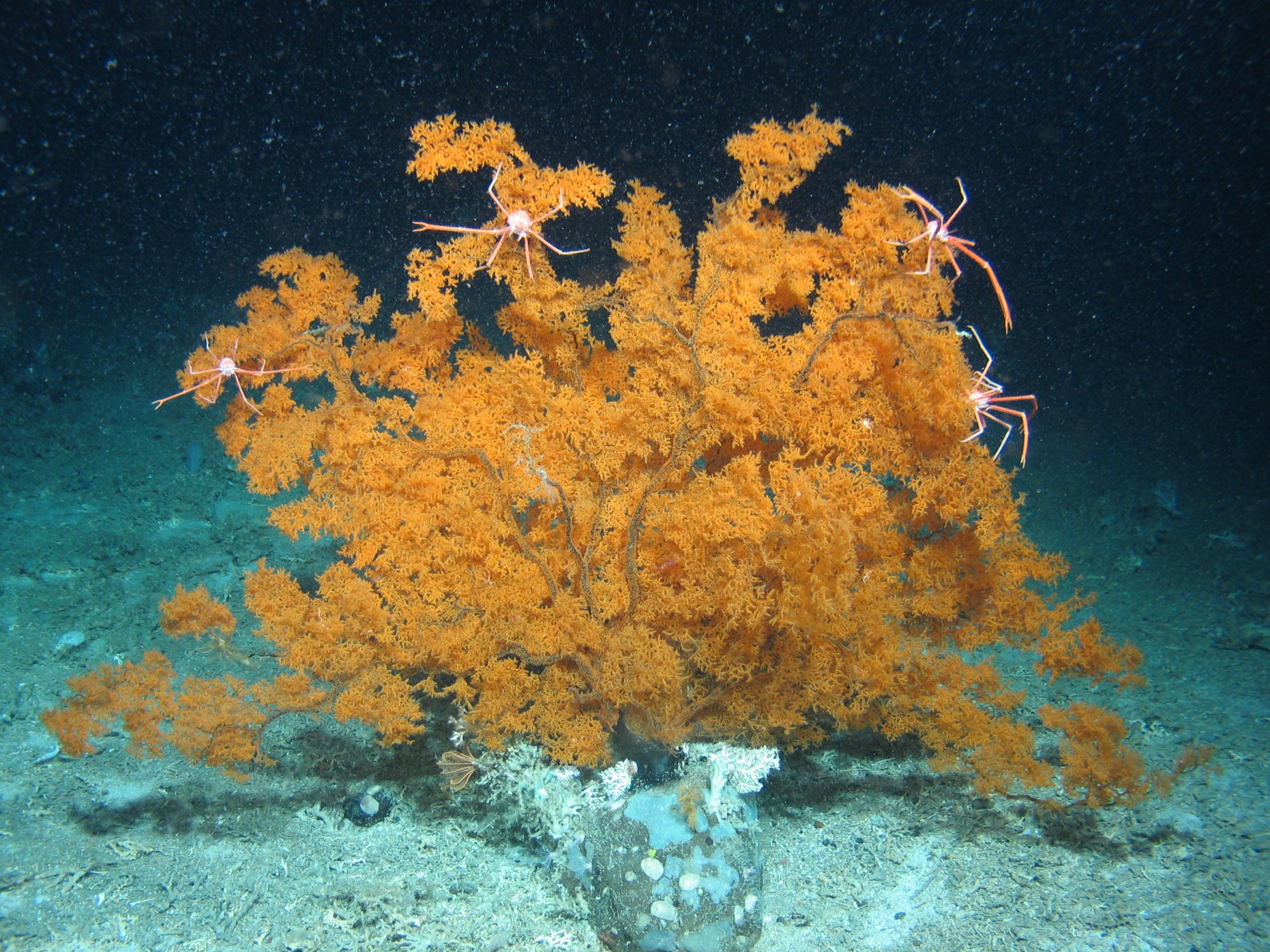
The Changing Oceans group is involved in a variety of different research projects, from blue skies research, to very applied research partnered with industry or policymakers. The broad theme of our research revolves around how Changing Oceans will impact upon marine ecosystems. This includes investigating how ecosystems will change in the future, questioning what this will mean to related communities, and how we will interact with them through management, policy and industry.
Below is a snapshot of currently funded or recently completed large projects. For specific research areas, please see our publications page and individual people pages.
ACTIVE
REDRESS – Restoration of deep-sea habitats to rebuild European Seas
 The REDRESS project is HORIZON-Innovation Action and UKRI-funded that began in 2024 and will run until 2028. This research project aims to make a key contribution to the EU restore degraded deep-sea ecosystems. A consortium of 27 institutions across Europe is working together to prioritise future restoration efforts, extend restoration to previously neglected deep-sea habitats, and demonstrate the feasibility, effectiveness, and ecological value of deep-sea ecosystem restoration. Using innovative methods tailored to both soft- and hard-substrate habitats, REDRESS will implement restoration activities at nine sites identified as vulnerable marine ecosystems. These include sea pens and bamboo corals on soft sediments, coral gardens, cold-water coral reefs, sponge fields, and cold seeps.
Professor Murray Roberts co-leads Work Package 2. Dr Simone D’Alessandro is the Changing Oceans Group researcher involved in the project, and Dr Anna Gebruk is the research project manager.
COMPLETED
iAtlantic – Integrated assessment of Atlantic marine ecosystems in space and time
The iAtlantic project is a whole-Atlantic EC H2020 funded project that run in June 2019 – March 2024.
iAtlantic concluded in March 2023. For a comprehensive overview of iAtlantic’s results and achievements, take a look at our Research Highlights publication.
iAtlantic has delivered knowledge that is critical for responsible and sustainable management of Atlantic Ocean resources in an era of unprecedented global change. Recently concluded, this ambitious project involved marine scientists from countries bordering the north and south Atlantic Ocean, seeking to determine the resilience of deep-sea animals – and their habitats – to threats such as temperature rise, pollution and human activities.
iAtlantic undertook an ocean-wide approach to understanding the factors that control the distribution, stability and vulnerability of deep-sea ecosystems. Work spanned the full scale of the Atlantic basin, from the tip of Argentina in the south to Iceland in the north, and from the east coasts of USA and Brazil to the western margins of Europe and Africa. Central to the project’s success was the international collaboration between scientists throughout the Atlantic region, with sharing of expertise, equipment, infrastructure, data and personnel placed at the forefront of iAtlantic’s approach.
Prof Murray Roberts is the project’s coordinator, Dr Lea-Anne Henry, Dr Sebastian Hennige, Dr Johanne Vad, Dr Laurence De Clippele, Christine Gaebel, Tom Grove, and Kelsey Archer Barnhill are changing oceans research group researchers involved in the project. Dr Anna Gebruk and Dr Theoni Massara are project managers.
ATLAS – A transatlantic assessment and deep-water ecosystem-based spatial management plan for Europe
The ATLAS project is a trans-Atlantic EC H2020 funded project that was launched in 2016 and ended in 2020.
Between 2016 and 2020 the ATLAS project worked across the North Atlantic to improve our understanding of complex deep-sea ecosystems in a changing ocean. ATLAS assembled the interdisciplinary expertise spanning social and natural sciences, environmental economics, policy and governance needed not only to develop new knowledge but to bring this straight to those shaping ocean policies at national, regional and international levels.
Find out more about ATLAS Key Achievements on the project legacy website http://www.eu-atlas.org
Prof Murray Roberts is the project’s coordinator, Dr Lea-Anne Henry, Dr Sebastian Hennige, Dr Johanne Vad, Dr Laurence De Clippele, Dr Georgios Kazanidis, Dr Laure Duran Suja, Berta Ramiro-Sánchez, Stephanie Liefmann, and Christine Gaebel are changing oceans research group researchers involved in the project.
One Ocean Hub – Global Challenge Research Funds
One Ocean Hub is an UK Research and Innovation funded project through the Global Challenges Research Fund which started February 2019 and will end in May 2024. Its research seeks to bridge current disconnections in law, science and policy and integrate governance frameworks to balance multiple ocean uses with conservation. It also strives to empower the communities to inform decisions based on multiple values and knowledge system. The One Ocean Hub aims to transform our response to the urgent challenges facing our ocean. The aim is to predict, harness and share equitably environmental, socioeconomic and cultural benefits from ocean conservation and sustainable use. The Hub will also identify hidden trade-offs between more easily monetized fishing or mining activities and less-understood values of the ocean’s deep cultural role, function in the carbon cycle, and potential in medical innovation.The Hub specifically addresses the challenges and opportunities of South Africa, Namibia, Ghana, Fiji and Solomon Islands, and will share knowledge at regional (South Pacific, Africa and Caribbean) and international levels.
Prof Murray Roberts, Dr Sebastian Hennige, and Kelsey Archer Barnhill are changing oceans research group researchers involved in the project.
Arctic Prize – Arctic productivity in the seasonal ice zone
Arctic Prize is a NERC funded project which started in February 2017 and will finish January 2021. This project is seeking to understand and predict how change in sea ice and ocean properties will affect the large-scale ecosystem structure of the Arctic Ocean. Seasonally and spatially varying relationships between sea ice, water column structure, light, nutrients and productivity and the roles they play in structuring energy transfer to pelagic zooplankton and benthic megafauna are investigated. The focus lies on the seasonal ice zone (SIZ) of the Barents Sea – a highly productive region that is undergoing considerable change in its sea ice distribution – and target the critically important but under-sampled seasonal transition from winter into the post-bloom summer period.
Dr Sian Henley is a co-investigator on this project.
ChAOS – The changing Arctic Ocean seafloor
 ChAOS is a NERC funded project which started in February 2017 and will finish January 2021. This is a multidisciplinary project to elucidate the impacts of declining sea ice cover in the Arctic Ocean on the biological communities and nutrient cycling in seafloor ecosystems, and the implications for carbon sequestration and burial. The ChAOS project aims to better understand how changes in the Arctic Ocean sea ice cover and water mass distribution will affect biological and biogeochemical processes at the seabed. The seafloor is a highly dynamic environment that hosts a wide variety of biota, and plays a crucial role in carbon and nutrient cycling and burial.
Dr Sian Henley is a co-investigator on this project.
 changingoceans.com