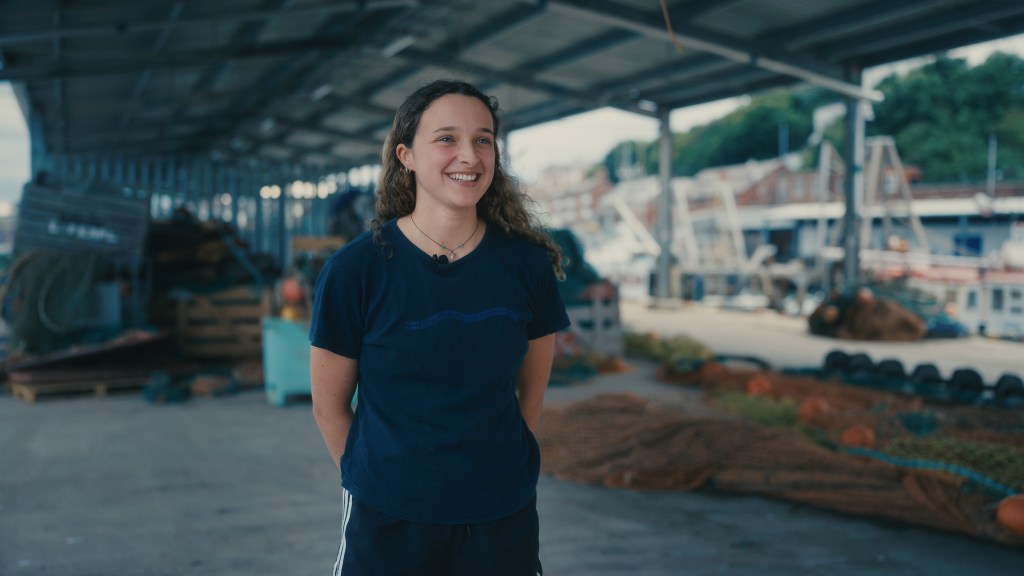
Mia McAllister – Research Assistant on the SharkScape project
The University of Edinburgh
School of GeoSciences
Contact: mia.mcallister@ed.ac.uk
Current Research
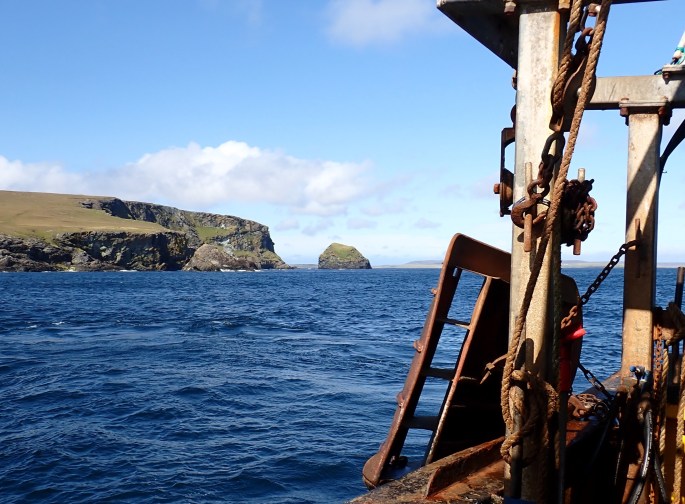
I am currently working as a Research Assistant on the SharkScape project, based at the University of Edinburgh. The overall aim of the project is to improve our understanding of the distribution and sensitivity of priority elasmobranch species in the central and northern North Sea, and west of Shetland. As part of my role, I am collating data on the occurrence and distribution of sharks, skates, and rays associated with offshore energy industries, to uncover new information on their populations and potential interactions with these developments.
My research background is focused on elasmobranchs and fisheries in the northern North Sea, specifically around Shetland, where I have led various elasmobranch research employing various methods such as BRUVS, diet analyses, and tagging. I also have experience conducting elasmobranch research in the Indian Ocean, specifically the Maldives, where I contributed to both research and community outreach initiatives.
I am particularly enthusiastic about finding collaborative solutions to sustainability and conservation, and value strong partnerships between science and industry. Through working on a gear trial project in the central North Sea, I saw first-hand how science-industry collaboration can lead to sustainable solutions for reducing bycatch, benefiting both ecosystems and stakeholders. I look forward to continuing this collaborative work during my time at the University of Edinburgh, particularly in the context of offshore energy industries.
Key interests:
Elasmobranch research, fisheries science, science-industry collaboration, biodiversity conservation
EDUCATION
BSc. Zoology, University of Edinburgh, School of Biological Sciences (2018-2022, 2:1). Dissertation titled: Life-history demographics, density hotspots, and potential nurseries for commercially exploited skates (class: elasmobranchii) around the Shetland Islands, Scotland.
Publications
Peer reviewed publications:
- McAllister, M., Fraser, S., Henry, L., 2024. Population ecology and juvenile density hotspots of thornback ray (Raja clavata) around the Shetland Islands, Scotland. Journal of Fish Biology 104, 576–589. https://doi.org/10.1111/jfb.15610
Reports/presentations:
- Fraser, S., Thomason, L., McAllister, M., Harlow, L. (2024). Shetland Inshore Fish Survey (SIFS) 2024: summary of catch rates, size compositions, and spatial distributions of commercial demersal fish species. UHI Shetland.
- Fraser, S., Angus, C., McAllister, M., Thomason, L., Ayres, S., Harlow, L. (2023). Shetland Inshore Fish Survey (SIFS) 2023: summary of catch rates, size compositions, and spatial distributions of commercial demersal fish species. UHI Shetland.
- Fraser, S., Ayres, S., McAllister, M., Thomason, L., Cubbon, K., Angus, C. (2024). Survey report for the 2023 Fair Isle inshore fish survey. UHI Shetland.
- McAllister, M., Fraser, S. (2023). Diet analysis and feeding ecology of the thornback ray (Raja clavata) around the Shetland Islands, Scotland. Poster session presented at UHI 2022/23 Research Conference – ‘Imagining Knowledge Futures’ , Elgin , United Kingdom.
- Lucey, N.M., César-Ávila, C., Eckert, A., Rajagopalan, A., Brister, W., Kline, E., Altieri, A.H., Deutsch, C.A., Collin, R. (2024), Coral community composition linked to hypoxia exposure. Global Change Biology. https://doi.org/10.1111/gcb.17545
 changingoceans.com