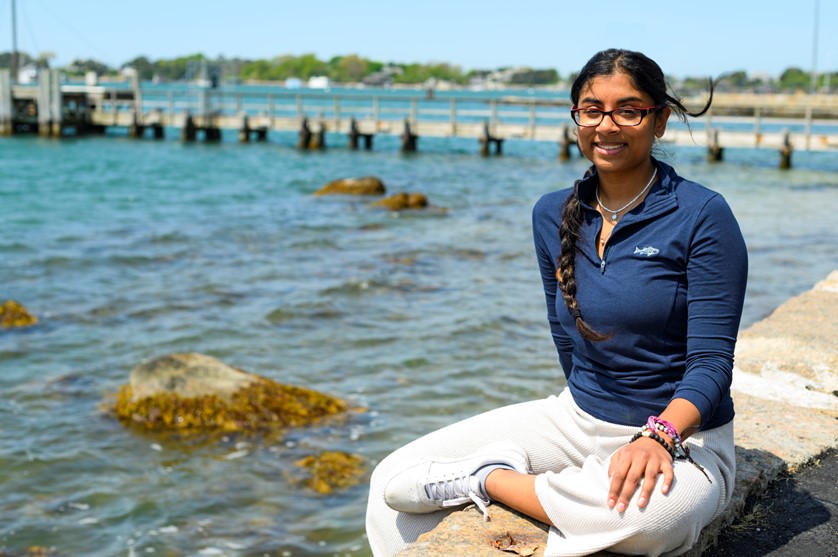
Anushka Rajagopalan (she/her/hers), MSc Student
The University of Edinburgh
School of GeoSciences
Contact: A.Rajagopalan@sms.ed.ac.uk
Current Research
I am a marine biologist currently pursuing an MSc degree in Marine Systems and Policies at the University of Edinburgh, expected to finish in August 2025. During this program, my graduate dissertation research will examine the impact of climate change on deep-sea marine organisms. Specifically, I am conducting a short-term experiment studying the effects of ocean acidification on the skeletal dissolution of cold-water coral (CWC) species Lophelia pertusa. As a new sustainable method to measure structural changes in surface area and dimensional loss in corals, the application of paraffin wax treatments will act as a substitute for live tissue. By using various scenarios of accelerated low pH stress and wax coverages, this can provide biologically realistic and quantitative answers into the structural and mechanical effect of acidification in real-time. Colony-size samples will be used in conjunction to individual fragments – this is significant, as these will serve as “mini-reef” projections where dissolution can also be observed on a relevant size scale.
The four main questions that shape this project are,
- (1) How can we develop more ecologically relevant cold-water coral specimens using a paraffin wax coating technique?
- (2) To what extent will the dissolution of these corals be impacted by introducing diverse ratios of simulated live tissue coverage?
- (3) How will the subjection of different acidification scenarios impact colony-size “mini-reef” structures?
- (4) To what degree can these new results create more accurate predictions of how CWC habitats may degrade?
Advisors: Dr. Kristina Beck, Dr. Sebastian Hennige
Impact
Climate warming and human activities have produced substantial global impacts on sensitivity, adaptive capacity, and composition across reef ecosystems. The excess anthropogenic input of carbon dioxide into the atmosphere, global thermohaline circulation, and regional upwelling of CO2-rich older water masses onto the continental shelf has created a byproduct of ocean acidification, a primary stressor of concern for CWC reefs and deep-sea habitats [IPCC, 2022]. Permanent environments where seawater pH is unsustainable for CWCs (WAragonite < 1.0) results in gradual dissolution of dead exposed skeletal material, known as “coral-porosis”, leading to rapid reef deterioration [Hennige et al, 2020]. While modeling techniques can serve as monitoring tools and quantify habitat risks, there is a notable gap to test and observe these predictions from individual coral fragments to ecologically relevant scales. Through my project, understanding the interaction between lower pH and skeletal degradation will contribute to future mitigative and restorative strategies being developed as the threat of acidification persists.
Past Experiences
Prior to starting my MSc, I completed a BSc in Ecology and Evolutionary Biology at Northeastern University, USA (2020-2024). During this degree, I was involved in two research projects each conducted at major institutions. In 2022, under Dr. Noelle Lucey at the Smithsonian Tropical Research Institute, I studied the combined temperate and hypoxic tolerances on three dominant tropical corals in Bahia Almirante, Panama – Acropora cervicornis, Agaricia tenuifolia, and Porites furcata. In 2023, under Dr. Don Anderson at the Woods Hole Oceanographic Institution, I investigated the scale and severity of a toxic dinoflagellate Alexandrium catenella bloom in Alaskan Arctic waters. I have become co-author to three publications resulting from these two projects.
Publications
- Fachon, E., Pickart, R.S., Sheffield, G., Pate, E., Pathare, M., Brosnahan, M.L., Muhlbach, E., Horn, K., Spada, N.N., Rajagopalan, A., Lin, P., McRaven, L.T., Lago, L.S., Huang, J., Bahr, F., Stockwell, D.A., Hubbard, K.A., Farrugia, T.J., Lefebvre, K.A. and Anderson, D.M. (2024), Tracking a large-scale and highly toxic Arctic algal bloom: Rapid detection and risk communication. Limnol. Oceanogr. Lett. https://doi.org/10.1002/lol2.10421
- Lucey, N.M., César-Ávila, C., Eckert, A., Rajagopalan, A., Brister, W., Kline, E., Altieri, A.H., Deutsch, C.A., Collin, R. (2024), Coral community composition linked to hypoxia exposure. Global Change Biology. https://doi.org/10.1111/gcb.17545
In Review:
- Lago, L.S., Pickart, R.S., Lin, P., Bahr, F., Fachon, E., Brosnahan, M.L., Pathare, M., Muhlbach, E., Horn, K., Rajagopalan, A., Anderson, D. (2024), Physical Drivers of a Massive Harmful Algal Bloom in the Chukchi Sea in Summer 2022. Journal of Geophysical Research – Oceans. https://agupubs.onlinelibrary.wiley.com/journal/21699291
Outreach:
- ACE Spotlight: Anushka Rajagopalan – https://environmentalchange.ed.ac.uk/ace-news-0; https://environmentalchange.ed.ac.uk/ace-spotlight-anushka-rajagopalan
 changingoceans.com