June 2, 2025
Blog post by Issy Key
This internship was completed under the Professional Internship Placement scheme, within the E4 DTP at the University of Edinburgh, with funding from NERC. The partner organizations were Discovery Bay Marine Lab, University of the West Indies, and the Khaled bin Sultan Living Oceans Foundation, who provided in kind support
I have just returned from an exciting three months as an intern at Discovery Bay Marine Lab (DBML), Jamaica. I was lucky to have funding for an internship through my PhD programme (the E4 DTP), so took the opportunity to explore a new area of work. As a final year PhD student, this was a welcome break from writing my thesis and it was invigorating to use my brain in a different way for a few months.
DBML is a research station on the north coast of Jamaica, and part of the University of the West Indies. It is a vibrant workplace, with a current focus on restoration of mangroves and Queen conch (a giant sea snail), as well as educating students of all ages and hosting international university field courses. I was welcomed into the close-knit team, and joined the six-monthly cohort of interns.
My primary task was to create educational materials on seagrass for high school students. This would be a new ‘sister programme’ to an existing course on mangroves, which was celebrating its 10-year anniversary this year (Jamaican Awareness of Mangroves in Nature, or ‘JAMIN’). This fantastic programme, led by the inspirational Amy Heemsoth of the American-based Khaled bin Sultan Living Oceans Foundation (KSLOF), involves students growing their own mangrove seedlings, testing the effect of different sediment types on growth, and planting the mangroves out near their school, all whilst learning about mangrove ecology and their importance for coastal protection. I had a lot to live up to!
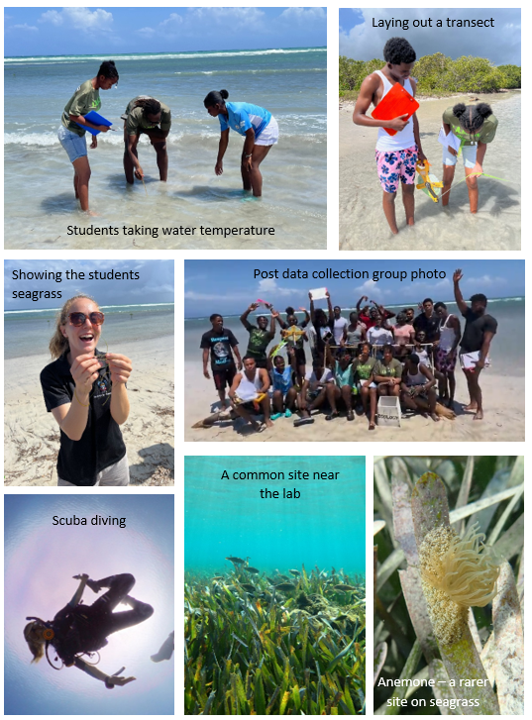
The new seagrass education programme (dubbed JASIN – pronounced ‘jazzin’), will have multiple phases, taking the students through what seagrass is, why it’s important and how we can protect it. I was able to plan content for the course, trial some lab experiments to be run in schools, and create and implement the first phase on understanding seagrass and its adaptations to the marine environment. This comprised classroom sessions and games, and a field trip where the students used quadrats to assess the distribution of different seagrass species at increasing distances from the shore. Despite the windy weather, and with the help of some ‘viewing boxes’ allowing us to see through the muddy water, the students collected some great data and had a blast splashing around in the water. They even added brand new seagrass sightings onto the global seagrass mapping project – Seagrass Spotter – making this the third site mapped for Jamaica!
Alongside this, I worked with the other interns to help with every-day running of the marine lab. This involved a great variety of tasks, including maintenance of the Queen conch lab, mangrove nursery, experimental coral nursery, and display aquaria. I became savvier about the ins and outs of aquaria maintenance, as well as how to trim mangrove roots at high speed. Everyday there was a new thing to learn – whether how to keep algal cultures growing or in which rock crevice to find a sea star for a touch tank. On ‘treat’ days, we got to go scuba diving and help with various tasks such as out-planting baby corals, scouting out sites for university field courses, or collecting invasive lionfish for the display tank.
This internship was packed with learning for me. I gained technical skills such as structure for motion photogrammetry and aquarium maintenance; practical skills such as species ID and conducting ecological surveys whilst diving; and teaching skills, including coordinating logistics of school field trips, and adapting my teaching style to students with varying levels of interest, focus and understanding.
I met so many wonderful people during my time in Jamaica. I was welcomed with open arms by the marine lab, who adopted me into their work family. I will also forever be inspired by some of the school students, whose passion and enthusiasm (often in the face of adversity) was infectious. I wish I could easily return to help see through the remainder of the education project, and to catch up with this fantastic bunch of people. Of course, it was also a treat to indulge in delicious Jamaican food (I became accustomed to fresh pineapple for breakfast), and be able to snorkel so often that I got to know individual fish! I have now returned to my PhD with a refreshed air, and renewed inspiration for my work.
 changingoceans.com