
This novel work will feed into an important gap we have in our understanding on coralporosis – how will the framework collapse? The accelerated treatments with the wax covering will give us a realistic proxy for how reefs with different amounts of live coral will change, feeding into future risk assessments of habitat loss

March 26, 2025
Blog post by Anushka Rajagopalan
When we think of coral reefs, we usually picture sunlit, tropical waters and sandy beaches – maybe the same place for a dream vacation destination. But what many people don’t realize is that those aren’t the only corals that exist. Deep below the ocean’s surface lies an equally fascinating ecosystem, Cold-Water Corals (CWCs). Unlike their warm water relatives, these corals do not rely on sunlight and can be found from 40-3000 m in depth. Despite a lack of research compared to tropical species, CWCs are crucial for reef compositions, habitat integrity, and supporting marine biodiversity.
As a MSc student in the Marine Systems and Policies Program at the University of Edinburgh, I am working with the Changing Oceans Research Group to uncover lingering questions we have about these deep-sea corals. In this blog, I’ll be sharing what I’ve learnt about CWCs, their overall importance, what affects them today, and more that I want to find out with my own research.
CWCs are usually restricted to deep oceanic waters at 4°C-12°C temperatures and 8.09 ambient pH. The complexity of their reefs allow them to serve as fish and invertebrate refuges, nutrient sources, and create high species diversity. Each individual CWC (fragment) is composed of exposed rubble and a “dead” coral skeletal framework, formed from the mineral aragonite that acts as a functional base for “live” soft tissue to grow on. This dead material is critical for large coral mound developments and sustaining external loads for other species.
CWC skeletons can form if they are above something called the “Aragonite Saturation Horizon (ASH)”, where the saturation state of aragonite is greater than 1.0. If there is an insufficient presence of carbonate ions in the water, the ASH drops below 1.0 and aragonite becomes undersaturated – which is a big problem for corals in that area that want to build their skeletons. Currently, the few reefs that are found to be below the ASH level have a significant absence of coral skeletal frameworks and overall low habitat complexity.
But how do reefs get to this state?
Climate warming and human activities have produced substantial global impacts on the sensitivity, adaptation and composition of reef ecosystems [4]. Anthropogenic activities such as burning coal, oil, and natural gas, deforestation, and chemical pollution all contribute to an excess input of carbon dioxide into the atmosphere.
When this CO2 dissolves into our oceans (the ocean absorbs 25-30% of human CO2 emissions per year!), it quickly breaks down into hydrogen and bicarbonate ions, lowering the pH and making seawater more acidic.
As a consequence, ocean acidification is a result that becomes a primary stressor of concern for CWC reefs and deep-sea habitats.
17% of the seafloor below 500 m in the North Atlantic Ocean is predicted to decrease 0.2 pH units by 2100. That might not seem like a lot, but when acidification lowers seawater pH, it reduces the concentration of carbonate ions in the water, creating a shallower ASH depth and leaving aragonite undersaturated. Permanent environments where aragonite levels are less than 1.0 eventually leads to the gradual dissolution of dead exposed coral skeletal material, known as “coral-porosis”, leading to rapid reef degradation.
By the end of the century, ~70% of the CWC reefs will be in undersaturated aragonite seawater. This incoming threat has left numerous concerns on whether CWC habitats can persist once the ASH depth has risen above them.
There have been studies over the past few decades (with notable publications by CORG members themselves!) quantifying the impact of future acidification on CWCs. However, this research is usually limited to using computational modeling or long experimental times with delays on obtaining live samples.
What is needed next to continue in this field is to create an experiment that does not rely solely on collecting live tissue samples, modelling techniques, considerable resource usage, or testing only bare skeleton specimens.
Therefore, the goal of my experiment is to study the dissolution of Lophelia pertusa (a common CWC species) skeletons, using the application of wax treatments as a mimic for live tissue, under short-term and accelerated low pH stress.
This project has the goal of facilitating realistic coral dissolution using more ethical and short-term methods and in real time. Instead of using laboratory resources on a longer experimental timescale, the pH values to be used are purposely extreme (e.g. pH 7.2) to get to accelerated points of acidification that could occur by the end of the century. Using paraffin wax on existing skeletons to simulate live tissue coverage will prevent live animal samples from being extracted. It will also allow this study to be more biologically realistic, rather than past studies solely experimenting on bare skeletons or using online modelling. By having diverse wax cover percentages, this can provide quantitative answers of what capacity can live tissue survive as its skeleton degrades. To compare against individual fragments, colony-size samples will also be experimented on, and will serve as “mini-reef” projections where dissolution can be observed on a relevant size scale.
The questions I am asking to frame this project are:
- (1) How can we develop more ecologically relevant cold-water coral specimens using a paraffin wax coating technique?
- (2) To what extent will the dissolution of these corals be impacted by introducing diverse ratios of simulated live tissue coverage?
- (3) How will the subjection of different acidification scenarios impact colony-size “mini- reef” structures?
- (4) To what degree can these new results create more accurate predictions of how CWC habitats may degrade?
This experiment will last 5 weeks from May-June 2025. Right now, I am busy preparing our laboratory space. This involves setting up aquarium tanks with regulators, sensors to measure seawater parameters, computers that will output CO2 needed for each treatment, waxing the fragments, and other technical busywork! After the experiment has finished running, the rest of my time will be analyzing the changes in dissolution that happened in weight, surface area, and wax loss via coding programs such as R-Studio.
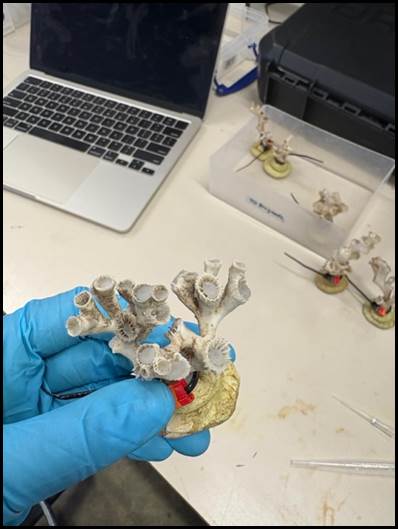

Setting up my experiment! – (Left image) An individual skeletal fragment with wax inserted into each polyp crevice to fill in any holes before I dip the whole piece. (Right image) Our “cold room”, which a lab usually uses for biologically sensitive experiments, is where mine will take place! Some tanks, their tubing and ProfiLux Aquarium Computers placed.
My research will provide greater understanding on the vulnerability of CWC habitats under various acidification scenarios. It presents beginning insights into using non-live materials as a more sustainable approach to understand long-term climate change trends.
Understanding the interaction between ocean acidification and skeletal degradation can also contribute to future mitigative and restorative strategies being developed as the threat of acidification approaches.
I’m excited to be getting a crash course in deep-sea biology and valuable skills on how to successfully run a marine-based experiment. Stay tuned for my next post, where I’ll hopefully be sharing the answers I found out along the way!
- Hennige, S. J., Wolfram, U., Wickes, L., Murray, F., Roberts, J. M., Kamenos, N. A., Schofield, S., Groetsch, A., Spiesz, E. M., Aubin-Tam, M.-E., & Etnoyer, P. J. (2020). Crumbling Reefs and Cold-Water Coral Habitat Loss in a Future Ocean: Evidence of “Coralporosis” as an Indicator of Habitat Integrity. Frontiers in Marine Science, 7, 668. https://doi.org/10.3389/fmars.2020.00668
- Wolfram, U., Peña Fernández, M., McPhee, S., Smith, E., Beck, R. J., Shephard, J. D., Ozel, A., Erskine, C. S., Büscher, J., Titschack, J., Roberts, J. M., & Hennige, S. J. (2022). Multiscale mechanical consequences of ocean acidification for cold-water corals. Scientific Reports, 12(1), 8052. https://doi.org/10.1038/s41598-022-11266-w
- Intergovernmental Panel On Climate Change (Ipcc). (2022). The Ocean and Cryosphere in a Changing Climate: Special Report of the Intergovernmental Panel on Climate Change (1st ed.). Cambridge University Press. https://doi.org/10.1017/9781009157964
- Kwiatkowski, L., Torres, O., Bopp, L., Aumont, O., Chamberlain, M., Christian, J. R., Dunne, J. P., Gehlen, M., Ilyina, T., John, J. G., Lenton, A., Li, H., Lovenduski, N. S., Orr, J. C., Palmieri, J., Santana-Falcón, Y., Schwinger, J., Séférian, R., Stock, C. A., … Ziehn, T. (2020). Twenty-first century ocean warming, acidification, deoxygenation, and upper-ocean nutrient and primary production decline from CMIP6 model projections. Biogeosciences, 17(13), 3439– 3470. https://doi.org/10.5194/bg-17-3439-2020
- Fernández, M. P., Williams, J., Büscher, J. V., Titschack, J., Roberts, J. M., Henninge, S., & Wolfram, U. (2022). Towards modelling cold-water coral reef-scale crumbling: Including morphological variability in mechanical surrogate models. https://doi.org/10.1101/2022.10.06.511005
- Sebastian Hennige, Kristina Beck, Cristina Gutiérrez-Zárate, Marina Carreiro-Silva, Inês Martins, Covadonga Orejas, Andrea Gori, Sophia Kleemeier, Sandra Marques, & Anais Sire de Vilar. (2024). Assessment of the effects of multiple stressors on the functioning of hard- bottom VME ecosystems (Deliverable 4.3; p. 111). https://www.iatlantic.eu/wp- content/uploads/2024/08/iAtlantic_D4.3.pdf
 changingoceans.com