
On the evening of Friday 17 November, we held a seminar to discuss how the Pitcairn Islands Marine Protected Area – one of the largest in the world – was created, and how researchers from the University of Edinburgh and the UK Government are collaborating to study its rich marine ecosystems, but also importantly how the local communities have been involved in creating and managing this vast area.
Please watch the recording here: Beyond the Bounty Seminar.mp4
[Please note, due to technical issues with the livestream system, presentation slides are not available during the first talk, and audio is not available for some video clips].

Pitcairn Island. Image courtesy Royal Society for the Protection of Birds (RSPB).
The evening began with an introduction by Prof. J. Murray Roberts (Professor of Applied Marine Biology & Ecology at the University of Edinburgh) on how plans had to come together rapidly in November 2022 for the Pitcairn expedition in February 2023. He gave a tantalising glimpse of video footage from the Nautile submersible during the 1999 POLYNAUT expedition, which showed some of the deep-sea corals, sponges, and anemones around Adams Seamount. Prof. Roberts also highlighted the development of the Azor drift-cam by the Deep-Sea Ecology Research team at the University of Azores in collaboration with iAtlantic.

Participants of the Azor drift-cam workshop 5-8 June 2023 with two fully functioning replicas of the camera system. Image courtesy Pepe Brix. iAtlantic blog on the workshop can be viewed here: https://www.iatlantic.eu/news/azor-drift-cam-training-2023/.
This very effective and low-cost piece of kit is planned for deployment in the Pitcairn MPA in 2025. In 2024 the University of Edinburgh team hope to expand their eDNA sampling and get new samples to begin monitoring ocean acidification at this important, and remote, South Pacific location.
Alasdair Hamilton, Deputy Governor of the Pitcairn Islands, gave an excellent overview of the history and governance of the Pitcairn Islands, which includes Pitcairn, Henderson, Oeno and Ducie. He showed a fascinating image of the beautiful Polynesian petroglyphs carved into a cliff at Pitcairn’s only beach. He also introduced us to The Blue Belt Programme and its role in raising the environmental profile of the Pitcairn Islands. This includes the development of a marine science base on Pitcairn to support research on fish stocks, coral reef biology, whale populations and more.
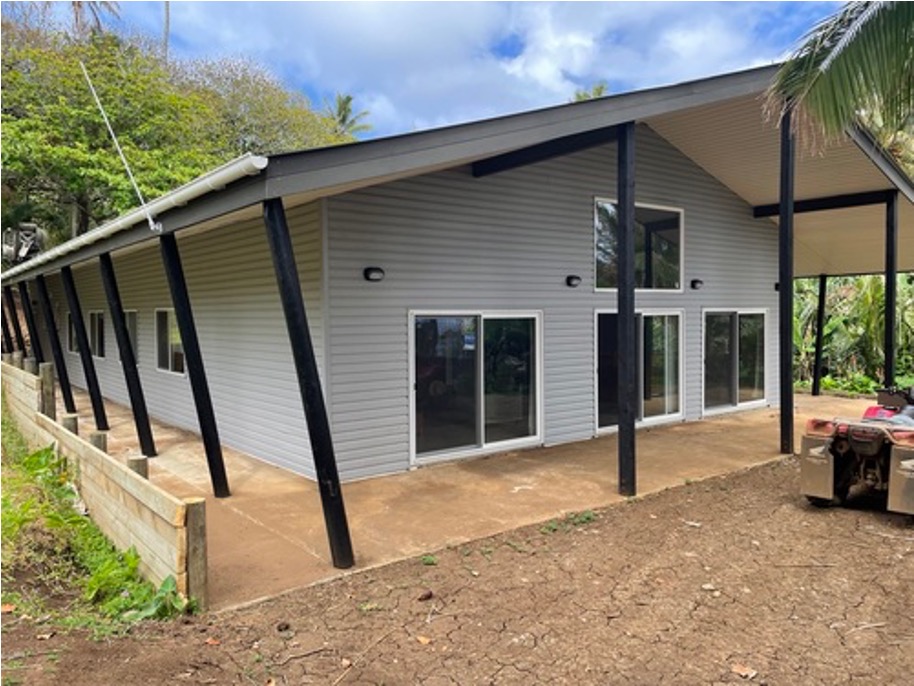
Marine Science Base on Pitcairn Island. Image courtesy Alasdair Hamilton.
One of the key environmental concerns is pollution, with a staggering estimated 4 billion plastic particles in the top 5 cm of sand on Henderson Island. He finished the presentation with a video of a mother and calf humpback whale, swimming in the gorgeous blue waters of the marine reserve.
Dr. Simeon Archer-Rand, Senior Marine Advisor at Cefas and Programme Director for the Blue Belt Programme, highlighted the importance of not just designating an MPA, but implementing effective management and monitoring of the environment for the protection of species, habitats, and cultural heritage. There have been very few scientific expeditions to the Pitcairn Islands, and less so with a focus on the marine environment. Dr. Archer-Rand showed us his work using a commercial satellite, which was processed to take the water column out and leave just the seabed around Pitcairn Island. From this, the distribution of different shallow water habitats could be inferred. A number of community science projects have also been built up on the island. These include the use of BRUVs (baited remote underwater video stations) which video coral reef habitats (showing no evidence of bleaching so far), reef fish and sharks.

Coral reef and fish assemblages displaying high biodiversity in waters around Oeno Atoll. Image courtesy Prof. Murray Roberts.
These also include fish stock analysis for 3 species around Pitcairn Island. This involves catching fish, measuring their length and height, examining their otoliths (fish ear bones) to determine the age of individuals, and examining their gonads to understand variations in reproductive cycles (e.g., spawning season). These programmes are ongoing and will develop in the coming years.
Prof. Rob Ogden (Chair in Conservation Science at the University of Edinburgh) has been working with Dr. Kirsten Harper (Postdoctoral Researcher in Conservation Genetics) on eDNA samples from Pitcairn taken during the expedition in February 2023. His talk began with an overview of the applications of eDNA to biodiversity monitoring, summarising the approaches, applications, and opportunities for using eDNA to answer questions around ecosystem health, invasive species, and community ecology. Pitcairn doesn’t experience industrial pollution or large-scale commercial fishing, so its environment gives us a special opportunity to study changes in community ecology from a near-baseline natural condition. For eDNA analysis, there were four main steps to the method which included (i) environmental sampling (ii) PCR (iii) NGS and (iv) taxonomic assignment:
- Read our Marine Forensics blog for a snapshot of eDNA sampling at Pitcairn. Water was sampled from target depths of 2-180 m at Adams Seamount, Henderson Island and Oeno Atoll. The water was injected through a filter, sealed, and stored frozen.
- The DNA present was extracted from a digested sample in an ultra-clean lab setting. A metabarcoding approach was taken using multiple PCR primers, used for different marine species groups such as microbes, corals, elasmobranchs etc.
- Next Generation Sequencing (NGS) produced billions of sequence reels, and these were disentangled bioinformatically.
- The sequences were then matched against reference databases to identify any species present and assess their relative abundance (to some extent).

DNA extracted from digested sample in ultra-clean lab. Image courtesy Dr. Kirsten J. Harper.
The sequencing results are expected any day now and this technology has huge potential with the possibility for collection and analysis to be conducted on-island at the Pitcairn marine science base.
Dr. Georgia Holly (Postdoctoral Researcher in Marine Archaeology at the University of Edinburgh) gave an excellent talk on communities and marine protected areas. Pitcairn Islanders are at the centre of the Pitcairn Islands MPA. Ongoing conversations and collaboration with the community, using customary frameworks such as the island council, are key to the successful management of the MPA. She explored the concept of Marine Cultural Heritage, which can include tangible heritage such as shipwrecks or built structures (e.g., lighthouses), and intangible heritage such as traditional ecological knowledge, customs, beliefs, livelihoods, and biocultural heritage (how nature and culture come together).
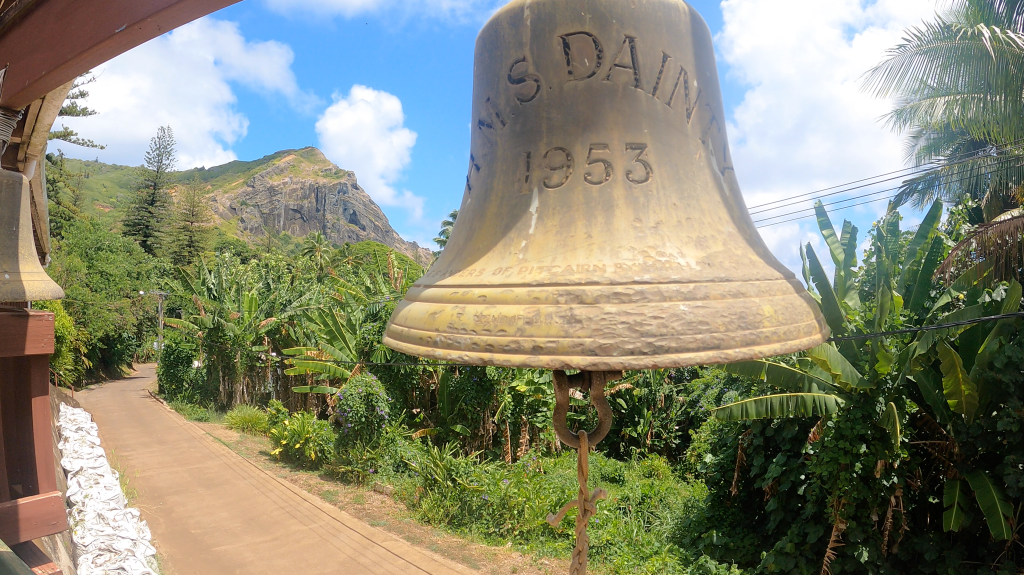
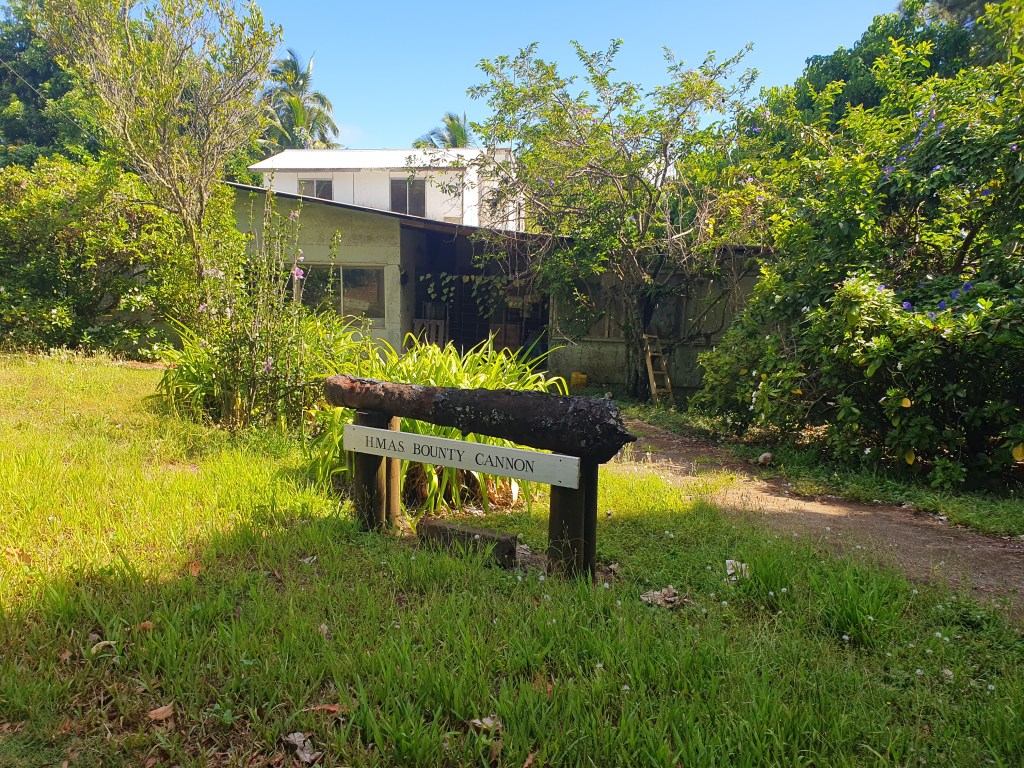
Top: Ship’s bell at the square where community gatherings take place. Bottom: Cannon retrieved from the wreck of the Bounty ship. Images courtesy Jason Cleland.
The Pitcairn Islands MPA is new, and this presents a unique opportunity to understand early on how the community has been involved in and engaged with the creation and management of the MPA. This involves looking at community acceptance, community inclusion and marine cultural heritage. Social surveys were conducted by the University of Edinburgh with the majority of the community on the Pitcairn Islands in February 2023. Dr. Holly highlighted the importance of recognising these surveys as a “snapshot in time”, conducted in collaboration with the community. They provide a perspective that can be used to enhance conversations and inform guidelines for management of the MPA in ongoing consultation with the community at Pitcairn. She discussed the outcome of these surveys: that there was a high level of acceptance of the MPA, that traditional fishing is integrated within management of the MPA, and that there was a high level of consultation and community engagement with the development of the MPA. Surveys showed community perceptions towards this were positive. There was a mixed level of community engagement and consultation in the management of the MPA, and perceptions of this were mixed, but most people would like to have more involvement in the MPA if they could. There was a huge amount of heritage documented within the interviews and there are opportunities for this to be further integrated into management. Dr. Holly identified that oral histories need to be collected urgently and traditional skillsets need to be documented.
We then had a pre-recorded video appearance from Pitcairn Islanders Michele Christian and Melva Evans (Pitcairn Division of Environmental Conservation and Natural Resources). The Pitcairn Islands won the Platinum-level Blue Park Award for exceptional marine wildlife conservation at the IMPAC5 conference in Vancouver this year (for more details on this, please see our blog post). Michele said, “the future we would like to see is that new technologies are piloted here on Pitcairn, new research models are done, so we invite you to bring your innovations”, and Melva said, “there is so much more to discover about the Pitcairn Marine Protected Area.”

Michele Christian (left) and Melva Evans (right) from Pitcairn Division of Environmental Conservation and Natural Resources, talking about the Pitcairn Islands MPA. Image courtesy Michele Christian.
We also had an appearance from Fiona and Steve Kilpatrick, Administrators of the Pitcairn Islands, who joined us (very) remotely from Pitcairn during a lively Q&A session. The evening was a wonderful summary of the work that has been done so far and an exciting pointer to research planned for 2024, 2025 and beyond.
We wish to thank everyone who joined in-person and online, our fantastic line-up of speakers, those who contributed to discussions, the university catering team for hosting our reception afterwards, and everyone who was involved in helping organise this event.
 changingoceans.com